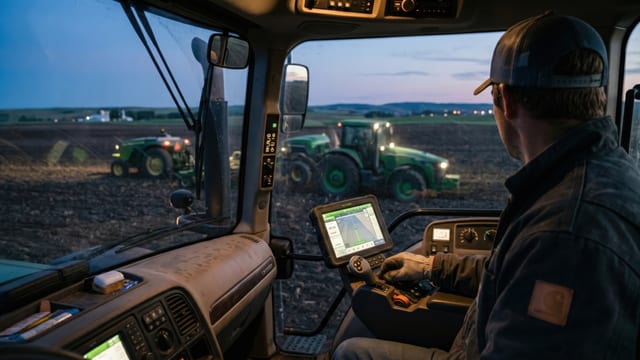
A standard panel does not become an equipment HMI simply because it fits the cutout.
Operators, sunlight, work gloves, moisture, dust, vibration, power, connectors, and service access all influence the touch-and-display assembly.
Where Mildex fits
Mildex develops touch screens, touch-display modules, and system products for industrial and transportation applications, including tractor and vehicle HMIs. That broader integration scope lets engineering teams discuss the operator interface, display, electronics, and mechanical envelope together.
What the cab and field change
Visibility. Direct sun, changing sun angle, dust on the surface, reflections, day/night dimming, and heat must be evaluated together.
Input. Work gloves, wet fingers, droplets, mud, palm contact, stylus use, and multi-touch expectations determine sensor and tuning choices.
Vehicle integration. Power quality, EMI, grounding, controller interface, harness, connector retention, cutout, and available depth affect the assembly.
Field durability. Vibration, impact, temperature cycling, moisture, cleaning, sealing, and serviceability should be defined for the actual equipment.
From operating requirement to integrated display
Mildex can coordinate the cover lens and printing, touch technology, controller behavior, surface treatment, optical bond, LCD, electronics, connector, and mechanical envelope. The result can be designed as a drop-in module or a more complete HMI starting point.
Requirement → engineering decision → integrated response
Equipment, operator and field conditions
Coordinate touch, optics, electronics and mechanics
Deliver a controlled assembly fitted to the vehicle envelope
Make the application—not the catalog—the selection filter
A PCAP module may be appropriate for thin-glove multi-touch and a seamless printed lens. Resistive or RMTS may be preferable when force activation, heavy gloves, wet contamination, or stylus use drive the interface. Mildex can evaluate more than one sensing path.
Brightness, temperature, sealing, and touch behavior must be confirmed on the selected LCD, controller, cover, bond, electronics, and enclosure configuration.
Design around the existing machine
The most useful starting package combines operating conditions with the real cutout, connector, harness, power, and service constraints.
- Cab cutout, cover outline, available depth and mounting
- Vehicle power, communication interface, harness and connector
- Operator PPE, contamination, sunlight, temperature and vibration
What to bring to the first discussion
- Display size, active area, resolution, brightness and day/night range.
- Glove, stylus, wet operation, palm rejection and touch-point needs.
- Sun exposure, reflection, surface treatment and bonding preference.
- Vehicle power, data interface, EMI and grounding conditions.
- Temperature, dust, moisture, vibration, impact and sealing.
- Cab cutout, cover-lens drawing, printing, connector and service access.
A useful starting point
Build a panel-selection brief in a few minutes.
Choose the size, viewing conditions, operating environment, touch behavior, and integration level. Submit the result with your work email and Mildex engineering will review it with you.
Agriculture application reference
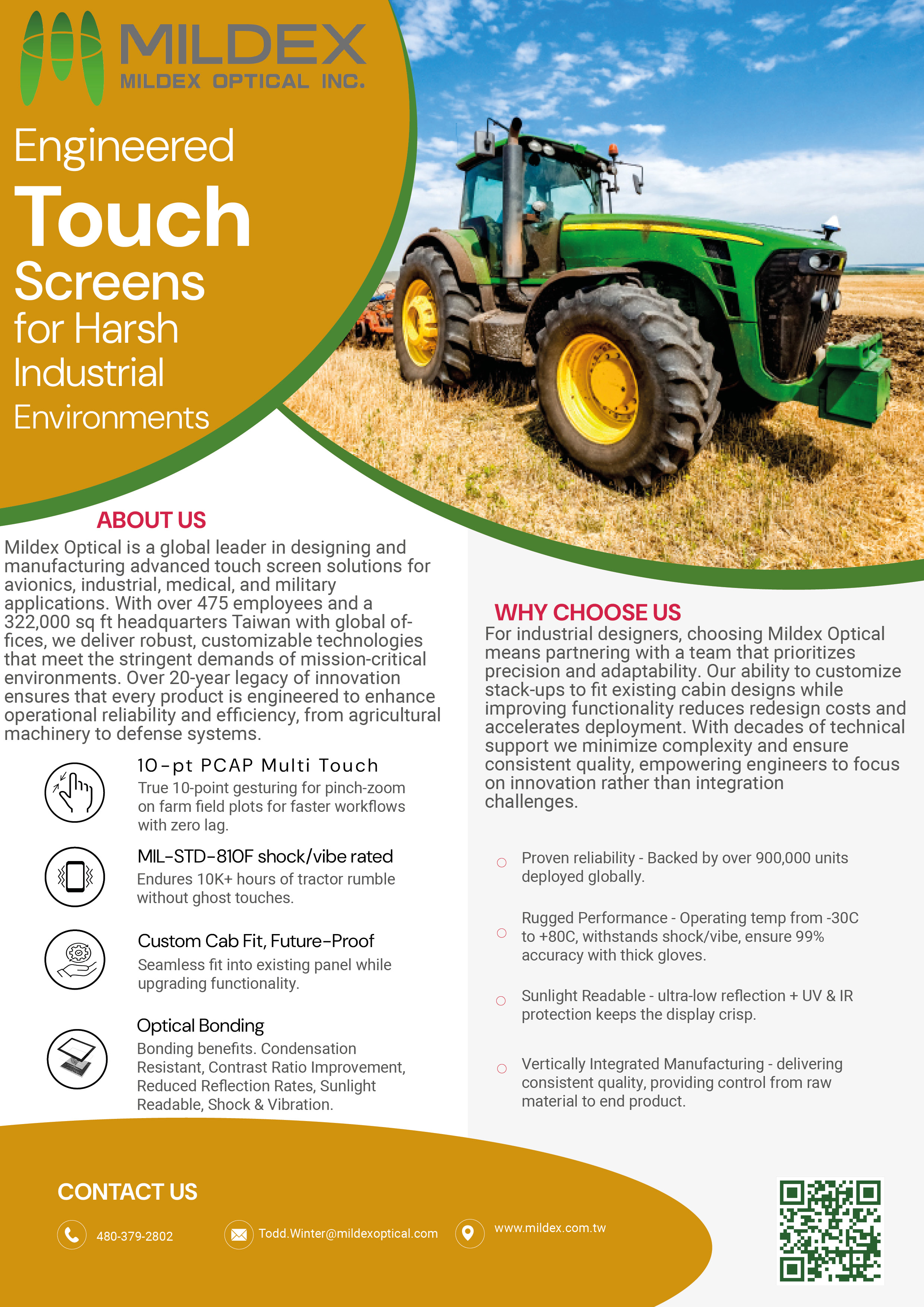
Agriculture display flyer
Open the current Mildex application flyer from the resources library.
Open flyerStart with the real application
Fit the display to the machine and the operator.
Share the cab envelope, interfaces and operating conditions. Mildex engineering can help select an appropriate touch-display starting point.