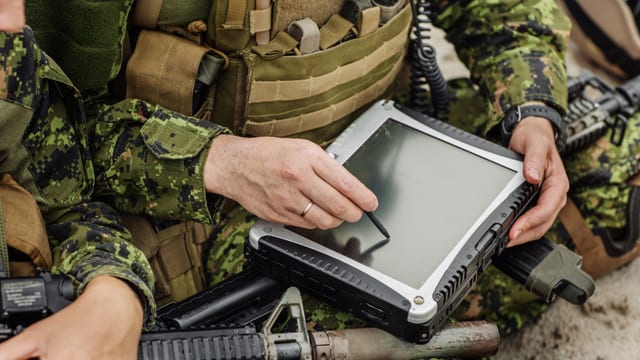
A defense display is defined by its program—not by a generic “rugged” label.
Gloves, sunlight, electromagnetic interference, shock, vibration, temperature, fluids, and mechanical installation interact at the front of the system. Selecting an LCD is only the beginning of that work.
Where Mildex fits
Mildex has years of experience supporting demanding defense touch and display applications, including fighter command systems, handheld controllers, rugged computers, and military vehicles. That experience helps engineering teams identify the interfaces and risks that a component-only LCD quote leaves unresolved.
What defense programs ask of the display
Operator input. The design may need deliberate operation with gloves, a passive stylus, or multiple simultaneous contacts. PCAP, resistive, and RMTS remain available so the sensing method can follow the mission requirement.
Visibility. High ambient light, viewing angle, reflections, and night-use requirements must be evaluated with the actual LCD, cover surface, optical treatment, and bond construction.
Electromagnetic behavior. The sensor, controller, shield, cable, bezel, and enclosure-ground path must be considered as one electrical interface.
Environment and mechanics. Shock, vibration, temperature, moisture, contamination, mounting, and connector retention act on the released assembly—not on an isolated panel.
From operating requirement to integrated display
Mildex can work from the platform requirements and coordinate the cover lens, sensor technology, surface treatment, controller, EMI approach, optical bond, LCD, and mechanical interfaces. The goal is a defined assembly that the customer can place into its own qualification process.
Requirement → engineering decision → integrated response
Platform, operator and qualification requirements
Select sensing, optics, shielding, bonding and interfaces together
Release one controlled display assembly for program evaluation
Experience matters before qualification begins
The value is not a blanket certification claim. It is experience translating demanding program inputs into a controlled configuration, drawing package, interface definition, and testable assembly.
Qualification remains configuration- and program-specific. Applicable methods, severities, fixtures, cables, grounding, and pass/fail criteria must be defined for the released assembly.
Support the customer’s qualification path
Bring the qualification basis into the design discussion early so materials, construction, mounting, and interfaces are not frozen before the requirements are understood.
- Applicable environmental and EMC requirements
- Mounting fixture, cable set, bezel and enclosure grounding
- Pre-test, in-test and post-test functional criteria
What to bring to the first discussion
- Display size, active area, resolution, luminance and interface.
- Glove, stylus, touch-point and wet-operation requirements.
- Viewing environment, coatings, reflection and night-use requirements.
- EMI environment, shielding objective and enclosure-grounding approach.
- Temperature, shock, vibration, moisture, fluids and sealing requirements.
- Cover-lens drawing, cutout, printing, connector and available depth.
A useful starting point
Build a panel-selection brief in a few minutes.
Choose the size, viewing conditions, operating environment, touch behavior, and integration level. Submit the result with your work email and Mildex engineering will review it with you.
Defense application reference
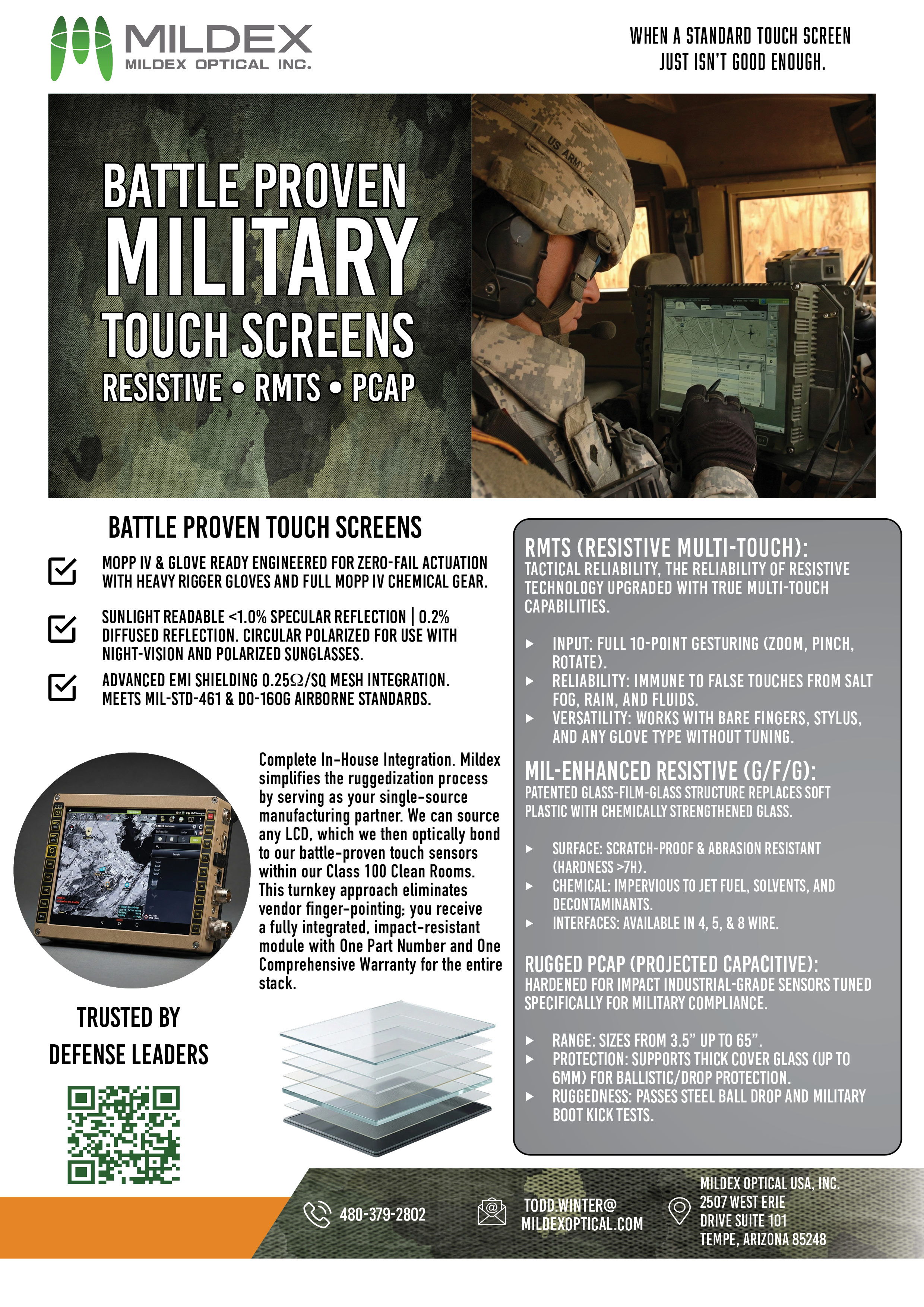
Defense display flyer
Open the current Mildex application flyer from the resources library.
Open flyerStart with the real application
Bring the program requirements into the display design.
Send what is known about the platform, operator, environment and qualification basis. Mildex engineering can help define a practical starting configuration.