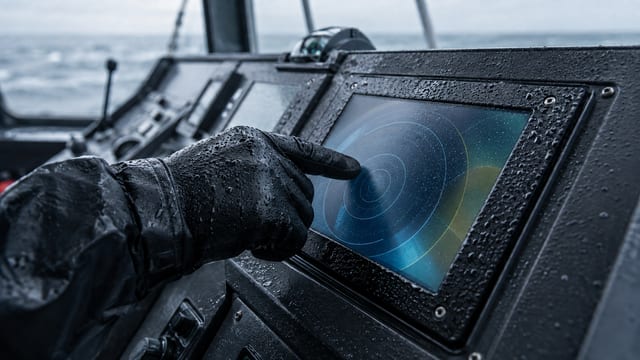
A marine display has to work at the interface between the operator, weather, vessel electronics, and enclosure.
Selecting a bright LCD does not resolve wet touch behavior, reflected sunlight, salt exposure, grounding, condensation, sealing, or the mechanical water path.
Where Mildex fits
Mildex supports marine and transportation touch-display applications and offers PCAP, resistive, RMTS, optical enhancement, bonding, EMI solutions, and complete module integration. Engineers can evaluate these choices against the actual bridge, deck, or cabin installation.
What marine use changes
Wet operation. Rain, spray, condensation, wet gloves, droplets, and standing water can produce very different behavior across PCAP, resistive, and RMTS designs.
Readability. Sun angle, glare, reflections, polarization, display brightness, surface treatment, and bonding must be balanced for the installation.
Electrical environment. Shielding, controller, cable routing, nearby radios and electronics, bezel contact, and enclosure ground influence touch stability.
Exposure and sealing. Salt, humidity, cleaning, temperature, edge design, gasket interface, drainage, and service access define the real environmental boundary.
From operating requirement to integrated display
Mildex can coordinate the cover, sensing technology, wet-input behavior, optical treatment, bonding, shielding, LCD, controller interface, and mechanical sealing surface as one controlled assembly.
Requirement → engineering decision → integrated response
Vessel, operator, weather and installation
Select input physics, optical path, grounding and seal interface
Evaluate one integrated assembly in the actual enclosure
Choose input physics for the water condition
PCAP can support wet operation when the lens, controller, tuning, grounding, and fluid condition are known. Force-activated resistive or RMTS may offer a clearer path where heavy gloves or persistent conductive water dominate. The right answer depends on the use case.
Marine suitability belongs to the full installation. Define the fluid, exposure duration, sealing boundary, enclosure material, grounding, mounting, and functional criteria for the released configuration.
Close the water path at the enclosure
A front surface can be robust while the edge, gasket, cable, or bezel remains the failure path. Review the complete mounting interface before release.
- Fluid type, spray direction, duration and wet-touch acceptance criteria
- Cover-to-bezel seal, gasket compression, drainage and edge construction
- Shield-to-enclosure ground, cable routing and nearby RF sources
What to bring to the first discussion
- Display size, resolution, luminance, interface and viewing position.
- Glove, finger, stylus, droplets, standing water and touch-point needs.
- Sun exposure, reflection, polarization, coatings and bonding.
- EMI environment, shielding objective, cable and enclosure grounding.
- Salt, humidity, rain, condensation, temperature and cleaning.
- Cover lens, gasket land, bezel, mounting, connector and service access.
A useful starting point
Build a panel-selection brief in a few minutes.
Choose the size, viewing conditions, operating environment, touch behavior, and integration level. Submit the result with your work email and Mildex engineering will review it with you.
Marine application reference
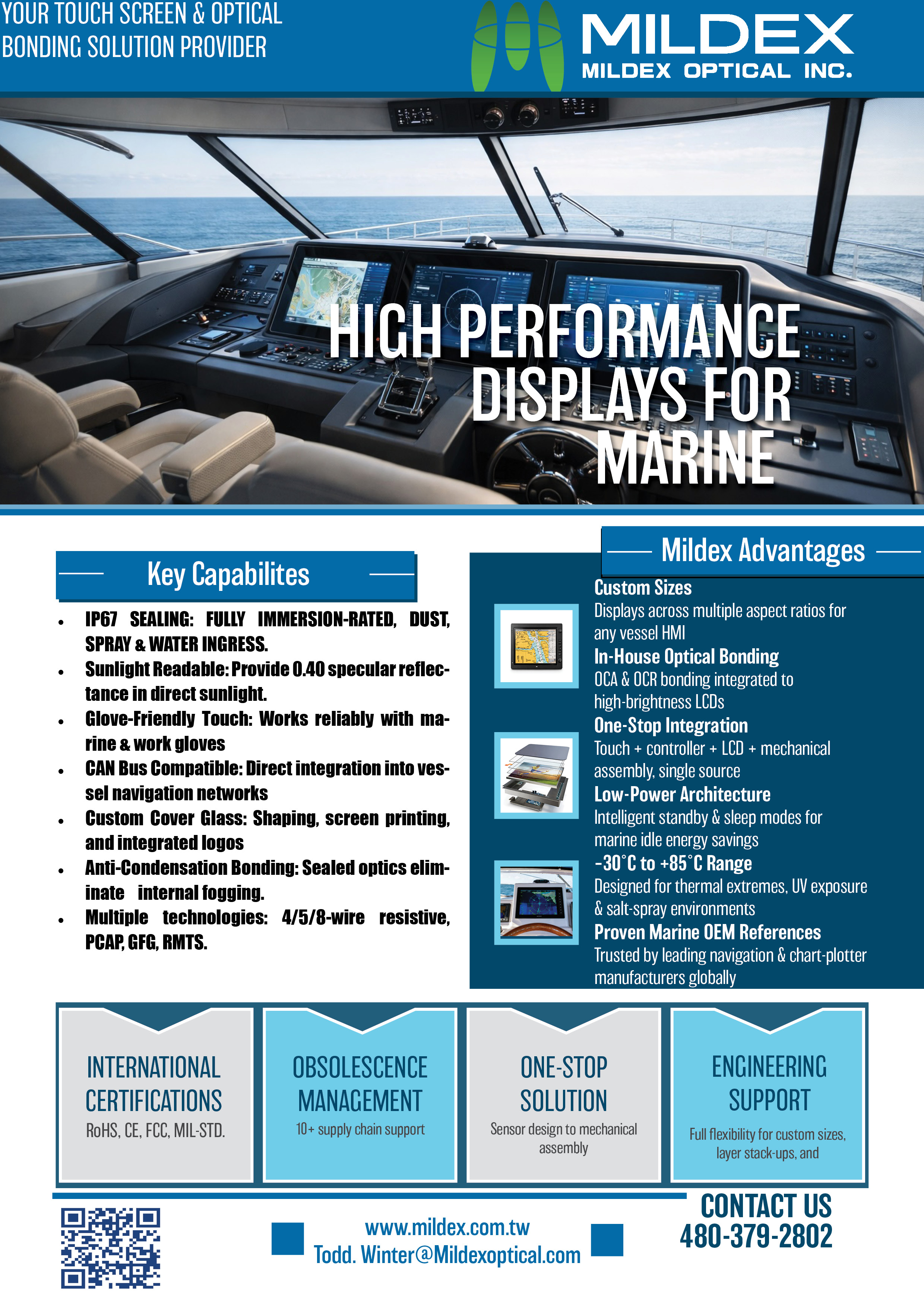
Start with the real application
Define the display against the vessel and the water path.
Send the input, optical, electrical, environmental and enclosure requirements. Mildex engineering can help select and integrate the right construction.