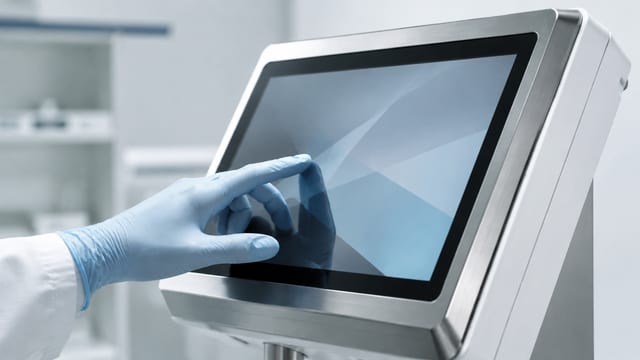
A cleanable medical interface is more than an LCD behind a hard surface.
The actual cleaning process, glove type, fluid exposure, touch behavior, cover geometry, optical construction, and sealing interface determine whether the finished display is appropriate for the equipment.
Where Mildex fits
Mildex has extensive touch-design and manufacturing experience for medical applications including diagnostic equipment, imaging systems, patient monitoring, respiratory equipment, and surgical systems. That background supports a requirements-led discussion without assuming that one construction fits every device.
What clinical use changes
Cleaning. Chemical type, concentration, dwell time, wipe material, temperature, and cycle count matter more than a generic “chemical resistant” label.
Touch behavior. Surgical or examination gloves, droplets, palm contact, active or passive stylus input, and deliberate activation may lead to different sensor and tuning choices.
Optics and surfaces. Anti-glare, anti-reflection, anti-fingerprint treatment, hardness, impact resistance, and optical bonding are separate decisions.
Integration. Cover-to-bezel sealing, controller placement, EMI/ESD strategy, cable routing, display selection, and service access must work together.
From operating requirement to integrated display
Mildex can coordinate the cover lens, surface treatment, PCAP or force-activated sensor, controller, bonding, display, shielding, and mechanical interface as one defined assembly. Engineers can then validate that configuration against the device’s own cleaning and qualification plan.
Requirement → engineering decision → integrated response
Clinical workflow, operator and cleaning process
Select surface, sensing, bonding, sealing and electronics together
Validate the released display assembly against the device plan
Separate the requirements that marketing terms blur together
Hardness does not prove chemical resistance. Optical bonding does not define sealing. Glove operation does not automatically prove droplet rejection. Each requirement should be stated and verified on the actual configuration.
Material and surface compatibility depend on the exact chemistry, exposure process, edge construction, coating, adhesive, and acceptance criteria.
Build a testable cleaning and touch requirement
A useful specification names the exposure and the expected behavior so engineering can recommend and validate the right construction.
- Agent name, concentration, wipe process, dwell time and cycles
- Acceptance criteria for haze, coating damage, edge seal and touch operation
- Glove, fluid, palm and stylus behavior on the final cover surface
What to bring to the first discussion
- Display size, resolution, luminance, interface and viewing requirements.
- Glove type, fluid exposure, stylus, palm rejection and touch-point needs.
- Cleaning agents, concentration, process, dwell time and cycles.
- Surface finish, hardness, optical and anti-fingerprint requirements.
- EMI/ESD, sealing, temperature and condensation requirements.
- Cover-lens drawing, printing, bezel, bond line, connector and service needs.
A useful starting point
Build a panel-selection brief in a few minutes.
Choose the size, viewing conditions, operating environment, touch behavior, and integration level. Submit the result with your work email and Mildex engineering will review it with you.
Medical application reference
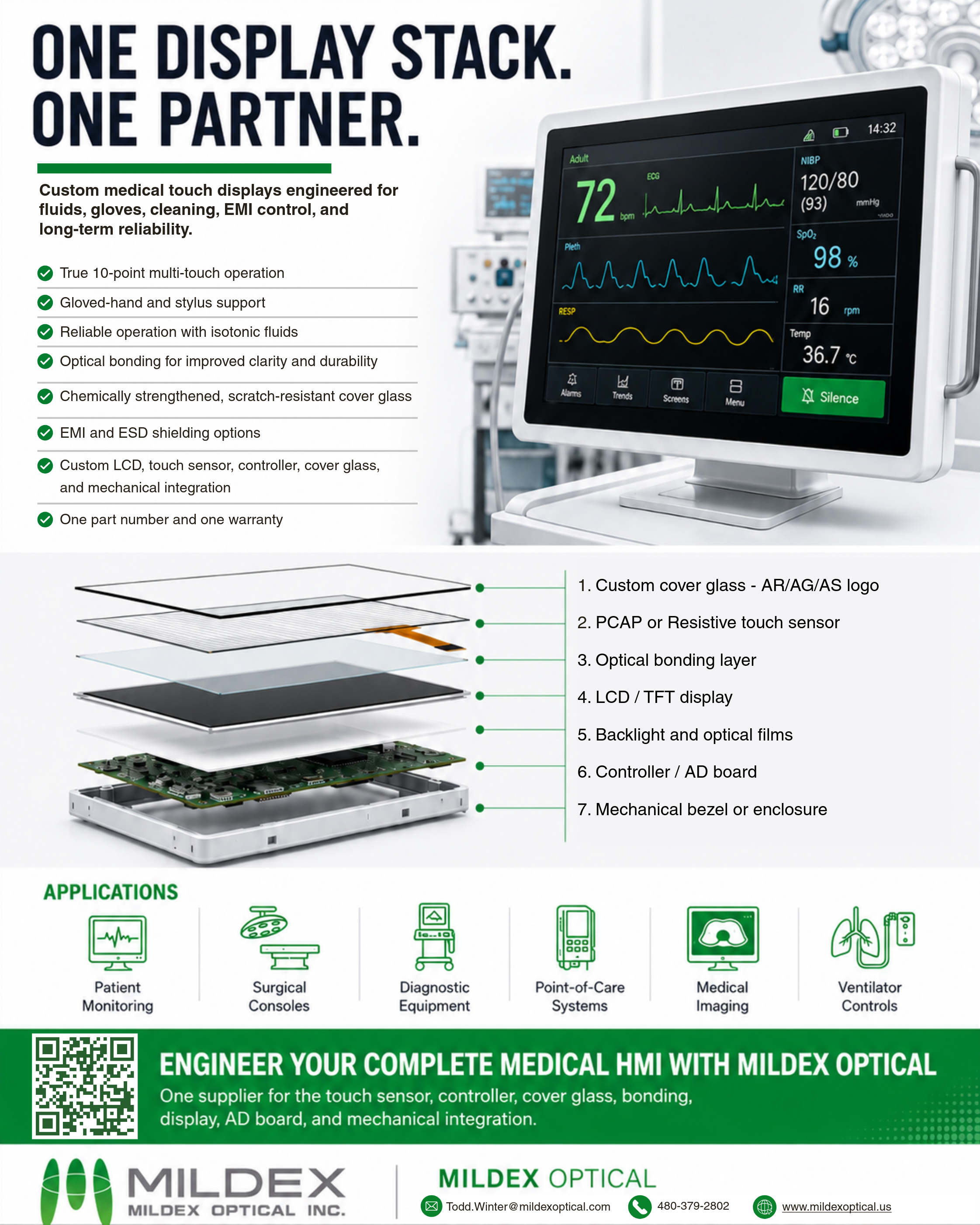
Medical display integration flyer
Open the current Mildex application flyer from the resources library.
Open flyerStart with the real application
Start with the cleaning process and operator.
Send the display, glove, fluid, cleaning, optical and mechanical requirements. Mildex engineering can help turn them into a controlled assembly.